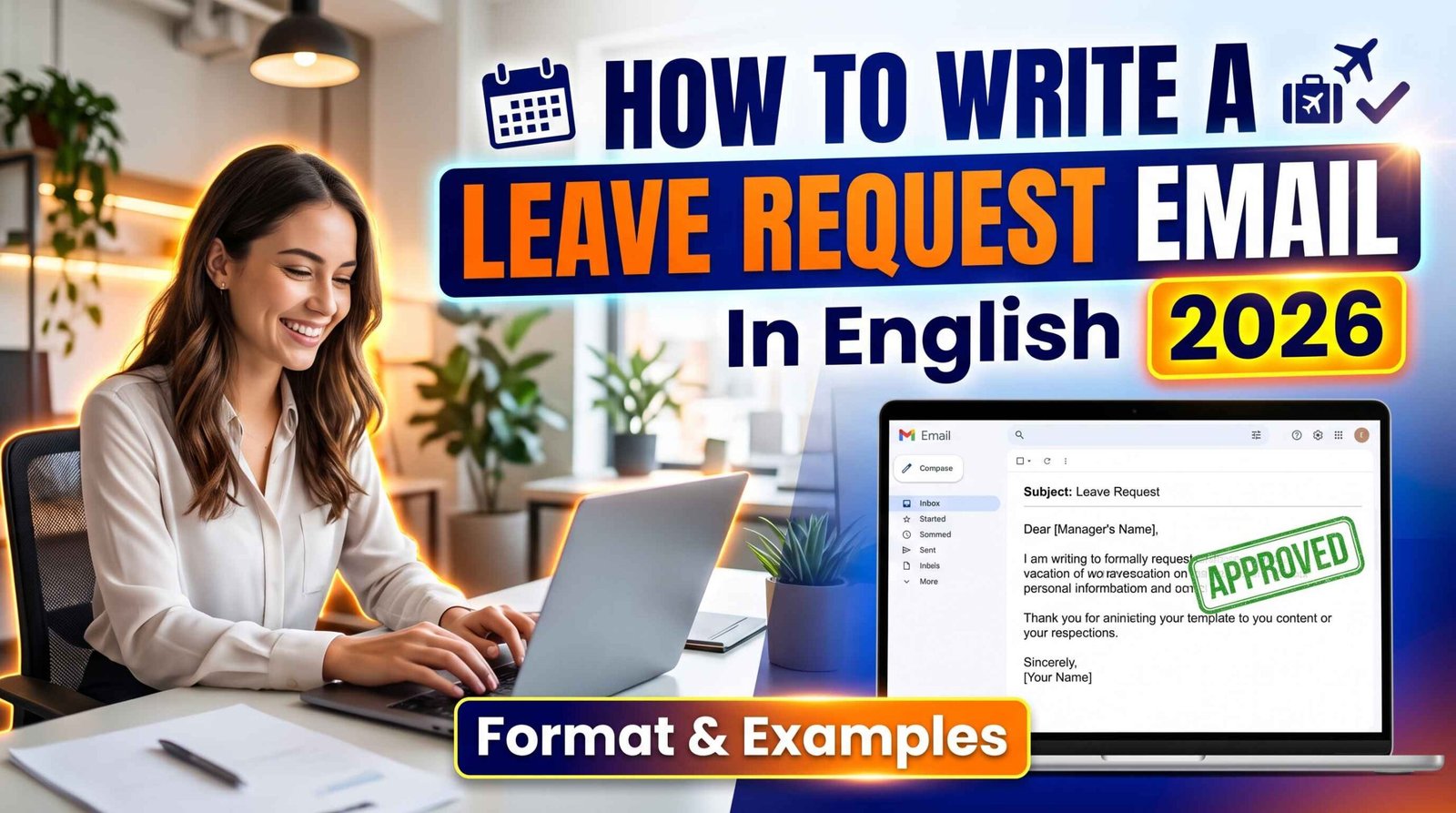
Learn how to write a professional leave request email in English with simple formats and examples for personal leave, sick leave, and vacations.
Taking time off from work is sometimes necessary. You may need a break for personal reasons, have a medical appointment, attend a family event, or plan a vacation. Whatever the reason, informing your manager professionally helps maintain clear communication and good workplace relationships.
A leave request email is one of the most common ways to ask for time off. Unlike an informal message, a professional email clearly explains why you need leave, specifies the dates, and politely requests approval.
In this guide, you will learn how to write a professional leave request email in English. We will also cover useful subject lines, essential elements, and practical examples for different situations that you can customize and send.
What Is a Leave Request Email?
A leave request email is a formal message sent to a manager, supervisor, HR department, or another authorized person to request time away from work.
Employees commonly use leave request emails for:
- Personal work or family responsibilities.
- Sickness or medical appointments.
- Annual leave or planned vacations.
- Family weddings and other important occasions.
- Emergency situations.
- Professional examinations or training.
A good leave request email should be clear, polite, concise, and sent according to your company’s leave policy.
Why Is a Professional Leave Request Email Important?
A professional email helps your manager understand your request without unnecessary back-and-forth communication.
It also creates a written record of your requested dates and the reason for your absence. This can help both you and your employer keep track of leave arrangements.
Most importantly, giving advance notice whenever possible allows your team to plan around your absence and manage important responsibilities.
Essential Elements of a Leave Request Email
Before writing your email, make sure it contains these important elements.
1. A Clear Subject Line
Your subject should explain the purpose of the email immediately.
Examples include:
- Leave Request for [Date]
- Annual Leave Request: [Start Date] to [End Date]
- Sick Leave Request for [Date]
- Request for Personal Leave
- Leave Request for Family Function
2. A Professional Greeting
Begin with a polite greeting such as “Dear Mr. Ahmed,” “Dear Ms. Khan,” or “Dear [Manager’s Name].”
If you are unsure of the recipient’s preferred title, using their name or the greeting “Dear [Manager’s Name]” is a safe option.
3. A Clear Reason for Leave
Briefly explain why you need time off. You do not need to share unnecessary personal information, but provide any details required by your workplace policy.
4. The Requested Dates
Mention the exact dates when you plan to be absent. If you are requesting several days, include both the start date and the expected return date.
5. A Plan for Pending Work
Where appropriate, explain how you will manage outstanding tasks, hand over responsibilities, or coordinate with colleagues.
6. A Polite Closing
End with a courteous request for approval and a professional sign-off such as “Best regards” or “Kind regards.”
General Format of a Professional Leave Request Email
You can use this simple template for most routine leave requests.
Email Subject: Leave Request for [Start Date] to [End Date]
Dear [Manager’s Name],
I am writing to request leave from [start date] to [end date] due to [brief reason].
I will ensure that my priority tasks are completed before my leave begins and coordinate with my team regarding any pending responsibilities.
Kindly consider and approve my leave request. Please let me know if you require any additional information.
Thank you for your understanding.
Best regards,
[Your Full Name]
[Your Job Title]
[Department Name]
Replace the details in brackets with your own information before sending the email.
1. Leave Request Email for Personal Reasons
Sometimes, you need time off to manage personal responsibilities, attend an appointment, or handle important paperwork. You can keep the explanation brief without sharing private details.
Example:
Subject: Request for Personal Leave on [Date]
Dear [Manager’s Name],
I would like to request one day’s leave on [date] due to an important personal matter that requires my attention.
I will complete my priority tasks before my absence and make the necessary arrangements for any pending work.
Kindly consider and approve my leave request.
Thank you for your understanding.
Best regards,
[Your Name]
2. Sick Leave Request Email
If you are unwell and cannot attend work, notify your manager as soon as reasonably possible. Follow your company’s rules regarding medical documentation and sick leave.
Example:
Subject: Sick Leave Request for [Date]
Dear [Manager’s Name],
I am feeling unwell and will be unable to attend work on [date]. I would therefore like to request sick leave for the day so that I can rest and recover.
I will keep you informed if I need additional time off and will follow the company’s sick leave procedure.
Thank you for your understanding.
Kind regards,
[Your Name]
3. Annual Leave Request Email for Vacation
If you are planning a vacation, it is usually best to request leave well in advance. This gives your manager time to review the dates and arrange work coverage if necessary.
Example:
Subject: Annual Leave Request from [Start Date] to [End Date]
Dear [Manager’s Name],
I would like to request annual leave from [start date] to [end date] for a planned vacation.
Before my leave begins, I will complete my priority tasks and coordinate with my colleagues to ensure that ongoing work is managed appropriately.
I would appreciate your approval of my requested leave dates. Please let me know if any further information is needed.
Thank you for your consideration.
Best regards,
[Your Name]
[Job Title]
4. Leave Request Email for a Family Function
Family weddings, engagement ceremonies, and other important occasions may require you to take time away from work.
Example:
Subject: Leave Request for Family Function – [Dates]
Dear [Manager’s Name],
I am writing to request leave from [start date] to [end date] to attend an important family function.
I will make sure that my priority responsibilities are handled before my leave begins and coordinate with the team regarding any pending tasks.
Kindly consider and approve my request for the mentioned dates.
Thank you for your understanding.
Best regards,
[Your Name]
5. Emergency Leave Request Email
Unexpected situations can arise without warning. In such cases, inform your manager promptly and explain the situation as clearly as you reasonably can.
Example:
Subject: Urgent Leave Request for [Date]
Dear [Manager’s Name],
I am writing to request urgent leave for [date] due to an unexpected personal matter that requires my immediate attention.
I apologize for the short notice and any inconvenience this may cause. I will update you regarding my availability and make arrangements for any urgent responsibilities where possible.
Thank you for your understanding and consideration.
Kind regards,
[Your Name]
6. Leave Request Email for Two or Three Days
When you need several days off, clearly state the full period rather than sending a vague request.
Example:
Subject: Leave Request from [Start Date] to [End Date]
Dear [Manager’s Name],
I would like to request three days of leave from [start date] to [end date] due to personal commitments.
I will organize my current tasks before my absence and coordinate with the team to ensure that important responsibilities are covered.
Please consider and approve my leave request for these dates.
Thank you for your time and consideration.
Best regards,
[Your Name]
Adjust the number of days and dates according to your actual requirements.
7. Leave Request Email for a Medical Appointment
If you have a scheduled medical appointment, you may need a full day or only a few hours away from work. Specify the duration you require.
Example:
Subject: Request for Time Off for Medical Appointment
Dear [Manager’s Name],
I would like to request permission to be away from work on [date] from [start time] to [end time] for a scheduled medical appointment.
I will plan my tasks accordingly and ensure that any urgent responsibilities are handled before I leave.
Kindly approve my request. If necessary, I can discuss an alternative arrangement to minimize disruption to my work.
Thank you for your understanding.
Best regards,
[Your Name]
8. Leave Request Email for Exam Preparation
Employees preparing for professional certifications, competitive examinations, or other career-related tests may need time off to study.
Example:
Subject: Leave Request for Exam Preparation – [Dates]
Dear [Manager’s Name],
I am writing to request leave from [start date] to [end date] to prepare for an upcoming professional examination.
I will ensure that my priority work is completed before the requested leave and coordinate with my colleagues regarding any outstanding tasks.
I kindly request you to consider and approve my leave application.
Thank you for your support.
Best regards,
[Your Name]
[Job Title]
9. Half-Day Leave Request Email
If you need only part of the working day off, mention the date and the hours clearly.
Example:
Subject: Request for Half-Day Leave on [Date]
Dear [Manager’s Name],
I would like to request half-day leave on [date] due to an important personal commitment.
I plan to be away from [time] to [time] and will complete my priority tasks accordingly.
Kindly approve my request. Please let me know if any additional arrangements are required.
Thank you for your consideration.
Best regards,
[Your Name]
10. Leave Extension Request Email
Sometimes, an unexpected situation may prevent you from returning on the originally planned date. In that case, contact your manager as early as possible and request an extension.
Example:
Subject: Request to Extend Leave Until [New Return Date]
Dear [Manager’s Name],
I am writing to request an extension of my approved leave until [new return date] because of [brief explanation].
I apologize for any inconvenience this change may cause. I will keep you updated regarding my return and coordinate with the team to address any urgent pending responsibilities.
Kindly consider my request and let me know if the extension can be approved.
Thank you for your understanding.
Best regards,
[Your Name]
Tips for Writing a Professional Leave Request Email
Following a few simple practices can make your email more effective and professional.
Write a Clear and Specific Subject
Your subject line should tell the recipient what the email is about. Avoid vague subjects such as “Important” or “Please Read.”
Request Leave in Advance
For planned vacations, family functions, and other predictable events, submit your request as early as possible. Follow the notice period required by your organization.
Be Honest About Your Reason
Provide an accurate explanation without exaggerating or inventing circumstances. Share only the personal details needed to process your request.
Keep the Email Short
Most leave requests do not require several paragraphs of explanation. A brief message with the reason, dates, and a polite request is usually enough.
Follow Up When Necessary
If your leave requires approval and you have not received a response, follow up politely before making assumptions about whether it has been approved.
Check Your Company’s Leave Policy
Different organizations have different procedures for annual leave, sick leave, emergency leave, and unpaid leave. Follow the applicable rules and submit any required forms.
Common Mistakes to Avoid
Avoid these mistakes when sending a professional leave request email:
- Forgetting to include the requested dates.
- Writing an unclear subject line.
- Using casual or disrespectful language.
- Giving unnecessary personal information.
- Sending a planned leave request at the last minute.
- Forgetting to check for spelling or date errors.
- Assuming your leave is approved before receiving confirmation.
- Failing to follow the company’s official leave procedure.
Taking a moment to review your email before sending it can help prevent misunderstandings.
Conclusion
Writing a professional leave request email becomes much easier when you follow a clear structure. Whether you need personal leave, sick leave, vacation time, or an emergency absence, make sure your email explains the reason, states the requested dates, and uses polite language.
Choose the example that fits your situation, replace the placeholders with your details, and review your company’s leave policy before sending it.
If you found these templates helpful, explore our other application and letter-format guides for more practical examples. You can also leave a comment if you have a question or need a specific email format.
1. How do I write a professional leave request email?
Use a clear subject line, address your manager politely, explain your reason briefly, mention the dates you need, and request approval. Include a plan for pending work when appropriate.
2. What is the best subject line for a leave request email?
A useful subject line is “Leave Request from [Start Date] to [End Date].” You can also use “Sick Leave Request,” “Annual Leave Request,” or “Request for Personal Leave,” depending on your situation.
3. How early should I send a leave request email?
For planned leave, send it according to your organization’s notice requirements and preferably as early as possible. For sickness or emergencies, inform your manager promptly.
4. Should I explain my personal reason in detail?
Usually, a brief and truthful explanation is sufficient. However, follow your employer’s policies if additional information or documentation is required.
5. Is a leave request email enough to get leave approved?
Not necessarily. An email is a way to make your request, but you should wait for confirmation and follow your organization’s official approval process.